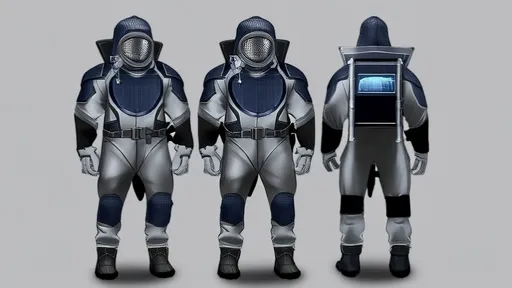
The concept of vertical farming has long been touted as a revolutionary solution to urban food production, but recent innovations are pushing the boundaries even further. One such breakthrough is the integration of crop growth monitoring directly into the fabric of vertical farming systems—literally. The emergence of "smart coveralls" or vertical farming smocks equipped with embedded sensors is transforming how growers interact with their crops. These high-tech garments are not just protective clothing; they are becoming an essential tool for real-time data collection and analysis in controlled environment agriculture.
Imagine walking through rows of vertically stacked lettuce or herbs while your clothing silently records temperature fluctuations, humidity levels, and even plant stress indicators. This is no longer science fiction. Advanced textile technologies now allow for the weaving of microscopic sensors into the very fabric of workwear, creating a seamless interface between farmer and crop. The data collected doesn't just stay on the garment—it's transmitted wirelessly to centralized systems where artificial intelligence algorithms process the information to provide actionable insights.
The implications of this technology extend far beyond convenience. Traditional crop monitoring in vertical farms often requires stationary sensors or handheld devices, both of which have limitations in coverage and frequency of data collection. With sensor-equipped clothing, every movement through the farm becomes an opportunity to gather critical information. The system creates a dynamic, living map of crop health that updates in real time as workers go about their daily tasks. This continuous stream of data allows for quicker responses to potential issues before they impact yield.
At the heart of these smart garments are flexible biosensors capable of detecting volatile organic compounds (VOCs) emitted by plants under stress. When certain crops experience nutrient deficiencies or pest pressures, they release distinct chemical signatures. The clothing's sensors can identify these subtle changes long before visible symptoms appear, enabling preemptive adjustments to lighting, nutrients, or climate controls. Some prototypes even incorporate nanotechnology that can detect plant pathogens at the molecular level, potentially stopping disease outbreaks before they spread through tightly packed vertical farm systems.
The data integration doesn't stop at plant health monitoring. These advanced workwear systems are being designed to sync with other smart farm technologies. Imagine your sleeve brushing against a growth tray and instantly displaying that section's last nutrient dosing or harvest schedule on a forearm-mounted flexible screen. The clothing becomes both data collector and display interface, reducing the need for separate devices that can be cumbersome in the confined spaces typical of vertical farms. Some manufacturers are experimenting with haptic feedback systems that gently vibrate when the wearer approaches crops needing immediate attention.
Privacy and data security present interesting challenges for this technology. As garments collect increasingly detailed information about farming operations, questions arise about who owns this data and how it might be used. Leading developers are implementing blockchain technology to ensure data integrity while allowing selective sharing with agronomists, farm managers, or equipment suppliers. The clothing itself is being designed with privacy in mind—for instance, ensuring that employee movement patterns can't be used for intrusive productivity monitoring beyond essential crop health metrics.
The environmental impact of these high-tech garments is also being carefully considered. Unlike disposable sensors or electronic devices that contribute to e-waste, these smart textiles are being engineered for longevity and recyclability. Solar-powered sensors that charge under grow lights, self-cleaning fabrics that resist the humid conditions of vertical farms, and modular designs that allow for easy component replacement are all part of the development pipeline. Some prototypes even incorporate plant-based biopolymers that can compost at the end of the garment's life cycle.
Adoption rates for this technology are climbing as vertical farming operations recognize the return on investment. Early adopters report significant reductions in crop losses and resource waste, with some farms seeing productivity increases of 15-20% in the first year of implementation. The clothing is particularly valuable for new employees, acting as a real-time training tool that helps them quickly learn to identify subtle signs of plant stress that might otherwise take years to recognize. As the cost of sensor technology continues to decrease, what began as specialized equipment for large commercial operations is now becoming accessible to smaller urban farms.
Looking ahead, the convergence of wearable technology and precision agriculture seems inevitable. Researchers are already working on next-generation versions that could incorporate plant communication signals or even direct nutrient application through the clothing itself. The vertical farming smock of the future might not just monitor plants—it could actively participate in their care, blurring the line between farmer and farm in ways we're only beginning to imagine. As urban agriculture continues to expand, these smart garments may well become as essential to vertical farming as the hydroponic systems themselves.

By /Jul 16, 2025

By /Jul 16, 2025

By /Jul 16, 2025

By /Jul 16, 2025

By /Jul 16, 2025

By /Jul 16, 2025

By /Jul 16, 2025

By /Jul 16, 2025

By /Jul 16, 2025

By /Jul 16, 2025

By /Jul 16, 2025
By /Jul 16, 2025
By /Jul 16, 2025

By /Jul 16, 2025

By /Jul 16, 2025

By /Jul 16, 2025

By /Jul 16, 2025

By /Jul 16, 2025